
- Iman Deschâtres
- 0 Comments
- 8009 Views
Unlike income taxes, which have a special line on a company’s P&L on which to report, there are additionally a bevy of other taxes often categorized as “transactional taxes”. Those taxes are generally directly impacting a company’s “operating profit ” line and hence its “operating profit margin”. In a perfectly-operating system, some (but not all) of these transactional taxes should get passed on to customers.
In reality, particularly in the evolving e-commerce marketplace world, the internal processes of many marketplaces and their customers are proving to be faulty, outdated, or simply naive as to the myriad complex obligations being imposed on e-commerce, resulting in unexpected liabilities that can destroy a company’s operating margin.
Marketplace Fees and the Hidden Impact of Taxes
When those taxes are actually passed on, they directly impact the perceived fee charged by the marketplace. An opinion piece by Tim Wu recently published in The New York Times states that “Last year, Amazon charged private sellers, on average, between 50 and 60 percent of their sales in fees…”. This claim is based on a paper from Market Pulse dated March 18, 2024, titled Amazon Fees Only Go Up. These fees include platform fees as well as FBA (fulfilled by Amazon) fees or advertising fees. The platform’s fee models are often complex, but what is less discussed is that these fees may also include taxes (either directly, or economically via their cost equivalence) collected by marketplaces on behalf of sellers, which affect the ultimate payout, or local taxes due by marketplaces and recharged to sellers in the form of fees to protect marketplace profit margins.
Key Taxes Impacting Marketplaces
There are multiple small local taxes that may be applied to certain product categories to finance specific initiatives. However, here we will focus on three taxes that are recurrent in many countries or are emerging: indirect transactional taxes (VAT, GST or sales tax), gross-based withholding tax levied on seller’s proceeds, and revenue-based digital services taxes, also referred to as “significant digital presence” taxes.
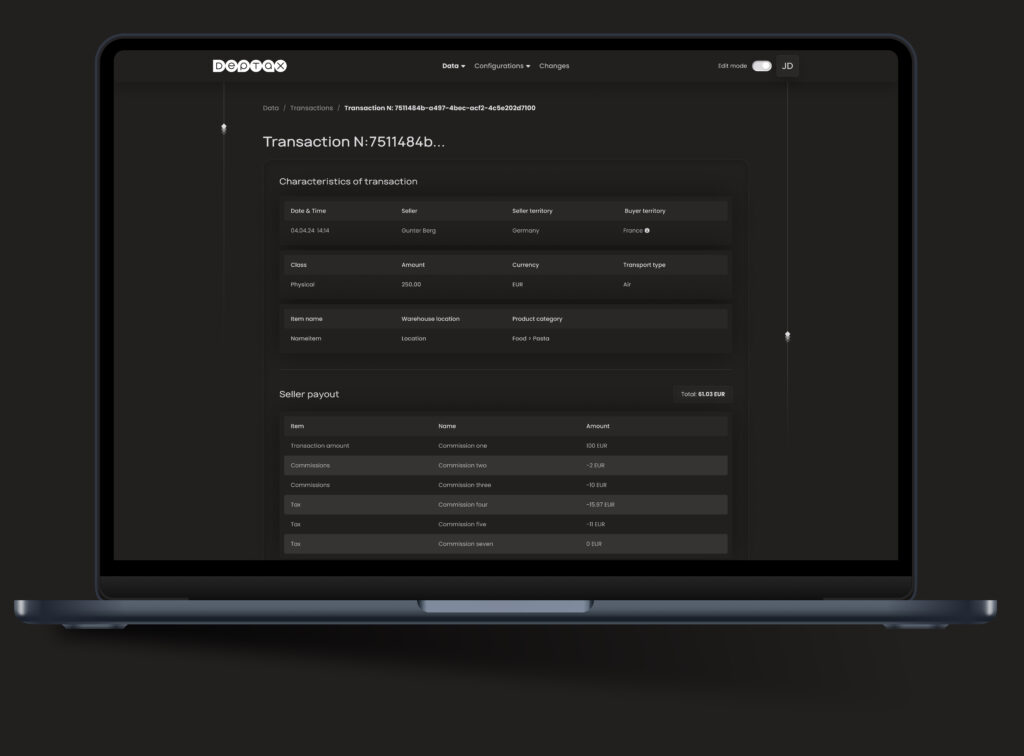
Indirect Taxes and Their Impact on Seller Payouts
First, it is important to note that unlike income taxes, NONE of these taxes relies on, nor is calculated based on, nor even requires the existence of, positive income resulting from the underlying transaction. Two of these taxes, indirect transactional taxes and withholding taxes on seller’s proceeds, reduce the payout to the seller and while they may initially feel like additional costs to a seller, they are in fact amounts the seller would have had to pay in any case. In practice and assuming the process is done correctly, netting these taxes in the first instance before the seller gets the proceeds, can actually represent a cost savings for the seller, who no longer has to deal with the administrative burden of calculating, filing and remitting these taxes or bearing the audit risk. However, things could go terribly awry if the process is not done correctly and the marketplace does not manage to correctly charge them in time and adjust the payout accordingly. They can easily become a final and direct P&L and cash cost for the marketplace and potentially (without taking into account interest, penalties and professional fees) exceed its entire revenue from the transaction.
VAT Liability and Marketplace Risk
“Marketplaces” (a statutorily defined term that has tended to become broader in practice and is expected to continue to broaden in scope) have been deemed liable for VAT on behalf of sellers since 2015 in Europe for digital services, and multiple countries around the world have followed this approach under OECD guidance. For physical goods, the situation is more complex: in some cases the Marketplace is liable for VAT, while in others the liability remains with the seller. This has created significant risk of confusion, unanticipated “surprise” costs and negative cashflow, and even instances of fraud where sellers do not truthfully disclose their information, resulting in no VAT being remitted. Amazon has recently raised this issue, and purportedly in the interest of clarifying role and responsibility, has asked the UK government to make Marketplaces liable for VAT in all circumstances. What does this mean for payouts and the perception of fees?
In practice, indirect tax rates worldwide range from around 5% to 27%. In Europe, the average standard rate is about 20%. Take the example of a product sold for 100 with 20% VAT, leading to a final consumer price of 120, and a marketplace commission of 10%.
✱ When the marketplace is liable for VAT, the payout to the seller will be 90. To the seller, this may look like a 25% “cost” (30 retained vs 120 paid), even though 20 of this is VAT.
✱ When the marketplace is not liable for VAT, the amount paid out to the seller will be 110, but the seller must then pay 20% of VAT to the tax authority, handle the administrative burden of collection and remittance, and bear the audit risk.
So in this very simple example, you will note that the net proceeds after tax is the same in both cases.
When VAT Is Not Deducted Properly
The above situation is transparently clear… However, it gets complicated if the marketplace is liable for VAT but fails to deduct it from the payout, it still owes and must pay the 20 VAT (plus potential interest and penalties), which can far exceed the 10 earned on the transaction. Indeed, it is 200% of revenue in our example above and without factoring in interest and penalties. On top of that, the marketplace also bears its own administrative and audit costs related to managing this tax, further reducing its profit margin. Whether the seller actually pays the corresponding tax due may (but not necessarily) ameliorate the liability of the Marketplace. In practice, relying on a third party settling your tax liability is like relying on strangers to mail your rent check each month – it is not a reasonable nor viable nor sustainable solution. Just remember, the marketplace and seller relationship – in place when the transaction (and tax liability) arises – can easily be long over at some date potentially years into the future when the tax auditor comes calling leaving the marketplace having to track down and chase a seller after the relationship is long over, or alas, holding the bag!!
Withholding Tax and Upstream Compliance
The mechanics of withholding tax on seller income have a similar disproportionately large profit margin impact to those of VAT in the example above. It is not an additional tax or fee, but an advance payment of the seller’s income tax in their country of residence or the country they sell into.
Sellers utilizing marketplaces are often treated as self-employed and must manage their own income tax obligations. However, historically, experience and anecdotal evidence have shown that some sellers may under-report their income or fail to set aside enough funds to pay their taxes. The OECD report on the effective taxation of platform sellers examined how to improve compliance. Two main approaches were considered: (i) requiring platforms/marketplaces to share information with tax authorities (as seen with DAC7 and similar rules), and (ii) imposing withholding tax on seller income, an increasingly common tool.
Withholding is attractive for tax administrations because it can deliver quite effective levels of compliance with relatively low administrative costs. It often operates close to real time and allows tax collection to be moved “upstream” in the cashflow chain, addressing behaviours such as error, evasion, fraud, or non-payment before they materialise.
However, if a platform cannot update its systems and payout flows in time, it could become the tax principal and be economically liable for the withholding tax coming out of its margin, and as noted above, it can very well have a pragmatically difficult time to try and recover these amounts from its sellers, relying on contract provisions, professional negotiations among advisors and “goodwill”.
And the “grace period” timeframe for getting systems up and running and fully implemented is getting shorter, as illustrated this summer by new rules in China, Vietnam, and Indonesia with almost immediate application and very broad base. In Vietnam, for instance, withholding obligations can apply not only to domestic sellers but also to foreign sellers with sales into Vietnam.
These withholding taxes may start as low as 0.5%, but often rise to several percent and can reach up to 26% in some cases (e.g. accommodation platforms obligation in Italy). Crucially, as pointed out above, the rate applies to the seller’s gross proceeds/revenue. In the example above, it would be applied to 90, while the platform’s commission is only 10, meaning that if the platform bears the withholding tax cost instead of the seller, it can easily exceed its entire revenue from the transaction. In the example above, even a low 3% rate of withholding tax due on the proceeds payable to the Seller would constitute a whopping 27% cost on the total revenue of the marketplace from that transaction and interest and penalties would be again in addition.
Digital Services Taxes and Significant Presence Rules
The analysis is more nuanced in the case of digital service tax (DST) or significant presence taxes. These taxes are likely to develop quickly with the OECD Pillar One discussions stalled.
The first issue is that the tax base differs from country to country. Traditional DSTs were originally targeted at large platforms, with both global and local thresholds, and applied only to platform income/fees. In such cases, the tax is calculated as a percentage of the fee, and platforms were in principle not supposed to charge it back to sellers. In some jurisdictions, legislation even explicitly prohibits marketplaces from passing it on. In practice, however, large platforms are able to adjust their fees so that the economic effect to both parties is as if they recharged these costs to sellers, and have the systems to adjust rapidly to changes. In that scenario, there could be an additional tax liability created – the economic equivalence of the DST would be reflected in the form of additional fees, on which additional VAT may also be due.
More recent rules introduce much broader “significant presence” taxes, sometimes levied on the full amount paid by the end consumer and with low or no thresholds, as in Kenya for example. In those cases, the question of whether to charge the tax back to sellers is no longer theoretical; it becomes essential in order to attain revenue protection, as illustrated by the example above.
Note the significant substantive difference between traditional DST’s – which are usually based on the revenue of the marketplace itself, namely its commission – and the Kenya example – which are based on much larger gross proceeds collected by the marketplace prior to passing on the amount due to the sellers. We won’t speculate on which calculation model might become the norm. However, given that tax policy aims to raise the greatest possible revenue in a “fair and equitable manner”, prudent risk management means that marketplaces potentially subject to a DST should ensure proactive, robust internal processes to minimise and manage this risk.
Accelerating Rule Changes and the Need for Agility
Historically, system update timelines were assumed to be at least six months, and this was reflected in OECD recommendations (lead time of 6 to 12 months for VAT reforms on digital service and 12 to 18 months for low value goods reforms). Recent developments show a very different reality: new rules are increasingly introduced with little or no lead time, even lead time being moved forward. It means – agility and transparency- is critical in a model where it is considered that moving from D2C retail model to a retailer marketplace requires relatively low capital investment yet are expected to deliver 7–9% EBITDA margins, mismanagement of tax and lack of governance can rapidly erode, or even totally consume , this incremental profitability. To protect operating margins, platforms now need agile, flexible systems that can be adapted to new regulations in minutes, without relying on multiple teams or long projects. At DepTax, we are the only solution designed specifically to make this level of responsiveness possible.
Disclaimer: The views, statements or opinions expressed in this article are solely those of the author and do not represent tax advice and are not to be designated to be the views, statements or opinions of any other person, group, association or company.
Image by: AtlasComposer
Want to know more? Please contact us at contact@deptax.com

